

I had a guest instant book for a checkin today. We have a st...
Latest reply
I had a guest instant book for a checkin today. We have a strict 4pm checkin time & they showed up at 2:15 saying they chose ...
Latest reply
Sign in with your Airbnb account to continue reading, sharing, and connecting with millions of hosts from around the world.

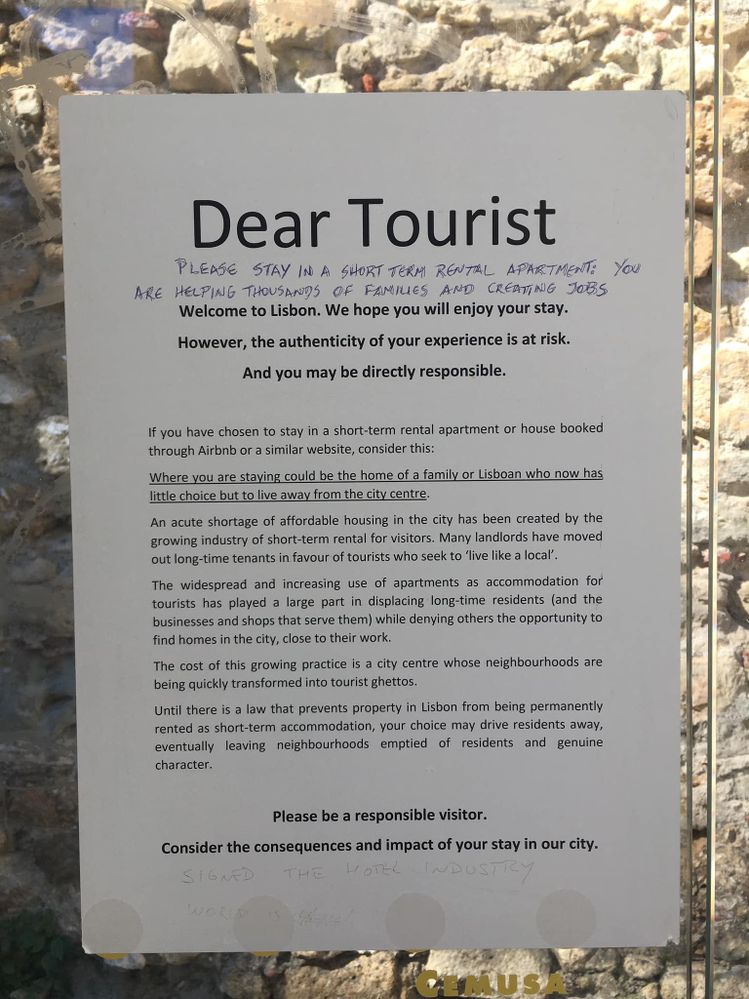
I fell across this image today and felt compelled to share it.
At first glance I thought “if only it were that easy to find the source of all Neighbourhood issues.” Whilst I can’t fault some of the logic, I find it wishful thinking to asssume that getting rid of Airbnb’s is the “one lever to cure it all”, yet that’s how the letter came across to my eyes. But I know next to nothing about the city this was written for.
And I haven’t had enough tea yet this morning 🙂
What do other hosts think about this? Any hosts from Lisbon about?
~ Ben
@Helen3 Well said. I know places like Denver in the US have been making headlines for a few years about being a city where it’s workers cannot afford to live. They say low to average income workers can’t afford to rent, let alone buy in Denver. I mention this one in particular because I saw a short doco on TV a while back where businesses in Denver were saying they can’t get the local workers they need. They covered all sides; the workers, businesses, council... it was pretty dire, and there didn’t seem to be a clear way out. The council were all about protecting the city greenbelt so didn’t think tearing down trees and building was the answer (yay)... it all stuck in my memory...

I have serious doubts that it's causing a housing crisiss. I would strongly suggest that, for example, apartments in prime locations like central London or mid-town Manhattan were never 'affordable' and will never be affordable, so we're really talking about preferencing rich tenants who would live in these buildings v. tourists who use them for STR, and the idea that no one seems to recognize is that STR will sometimes allow the non rich to still live in these types of areas. The idea that if NYC manages to kill every single STR that this is going to free up some massive stock of affordable housing in unrealistic boardering on criminally silly. The same goes for vacation areas, making STR illegal will simply put it back to the way it was before, where only the wealthy will be able to afford the costs of paying a management company, and everyone else's houses will just be empty for the season, or at best, the less wealthy will make much less money off their property because they're forced to use a management company, if people living in beach communities think that eliminating airbnb is going to change the vacation rental market, again, they're being silly and unrealistic.
Yes, it may be that there are some areas on the margins where STR is used now where it wasn't before, and so there is some added pressure on housing or where corporate entities have bought up apartments for STR instead of long term, but I really doubt this is significant to be causing a crisis. The vast majority of airbnb's that are whole units are upscale and would never be classed as 'affordable' to begin with.
@Mark116 I agree, I think it would a considerable stretch to say that STR’s have caused a housing crisis, by themselves...
I know in NZ the housing crisis steps back to key decisions and regulations in the 70’s and 90’s, which created long term issues with the quality of housing stock. Beyond that poor regulation and bad fiscal management led to an over inflation of housing stock (reserve bank did nothing to stop it). For example, while the rest of the world had a crash in 2008-9, NZ housing prices soared! This created what they now call “generation rent”, meaning a generation of people who will now never afford to buy a house.... then in cities like Christchurch and Wellington the housing market has also been impacted by earthquake damage.
Truly, Airbnb came along years after the housing crisis was in full swing in NZ. So it certainly wasn’t the cause but, if you take points made by Sarah, Kath and Helen, it’s certainly something to curb and not make the problem worse.
For this reason, I fully support the NZ government in their plans to break the cycle of homelessness in my city. They have started by encumbering overseas property ownership. Until recently, we had a lot of overseas buyers (particularly the wealthy nations near to our part of the world) picking up NZ property and throwing it into STR’s. Madness right!? NZ laws were not in place to stop it. So they’ve dealt with it now, finally. Recently 2 houses went up for sale in my street and, before the law changed, I could have guaranteed that overseas buyers would have picked up both, then I would have 2 new Airbnb competitors.... however, I’m pleased to report that 2 NZ families will now be our neighbours! This is the right outcome.

Sorry @Mark0 I can't agree.
In London for example, Airbnb is not just available in prime locations - it is available across the capital including in the poorest areas; so it is not just a case of rich V airbnb as you claim.
People in poorer areas are being priced out as rents rise because of a growing shortage of long term rented accommodation (not just because of Airbnb but it is a contributing factor). In fact in London there are growing concerns about the impact on our world class city as our young people and young families are moving out as they can't afford to live there.
I would be very suprised if it was not the same in NYC.
It would be criminally silly to ignore the impact STRs are having on the communities in which they are based, on the availability of accommodation and on the wider economies of the areas in which they are located.
As I've said before lets not stick our heads in the sand as airbnb owners and ignore the impact of the business we run on the communities in which they are based.
Lets try and work together to come up with solutions that benefit all. Regulation is a necessary step in coming up with more equitable solutions.

And it is exactly those whole house rentals, bought up specifically to rent out on Airbnb, that have led to these regulations. Noisy parties, hoards of people coming and going, parking where they block neighbor's driveways, etc, attract the attention and displeasure of neighbors. Traditional home-sharing hosts who either host in their homes or have an STR they renovated or built to Airbnb are aware of what is going on in their rental, shut down bad behavior and have relationships of respect with the majority of their neighbors. It's a real drag that the whole house listings that aren't well-monitored are leading to crack-downs that affect all hosts.
I would make an exception for those hosts, like @Branka-and-Silvia0 who may have bought an apartment or house to STR, but are very much involved with paying attention to what goes on with guests, and handle everything themselves. As opposed to property managers or hosts with tons of listings who aren't present and vigilant.


